A government post is read on a phone, in a hurry, by someone who did not follow the page to be entertained. They want to know what is happening, whether it affects them, and what to do. Everything else is in the way.
The standard is also different. A campaign for a brand can be clever and wrong. A post carrying the national seal can only be right. These are the rules we work to, drawn from running public communication including the Ministry of Power, Energy & Mineral Resources’ Power & Energy Week.
1. Register: write to one citizen, in the Bangla they speak
Office Bangla — the language of circulars and file notes — is correct and almost unreadable on a phone. Social posts should be in standard, everyday Bangla (প্রমিত চলিত ভাষা), addressed to one person as আপনি.
এতদ্বারা সংশ্লিষ্ট সকলের অবগতির জন্য জানানো যাচ্ছে যে…
আগামী শুক্রবার সকাল ৯টা থেকে দুপুর ১টা পর্যন্ত এই এলাকায় বিদ্যুৎ থাকবে না।
The second version says what, where, when — in one sentence a citizen can act on.
2. Sentence length: one idea at a time
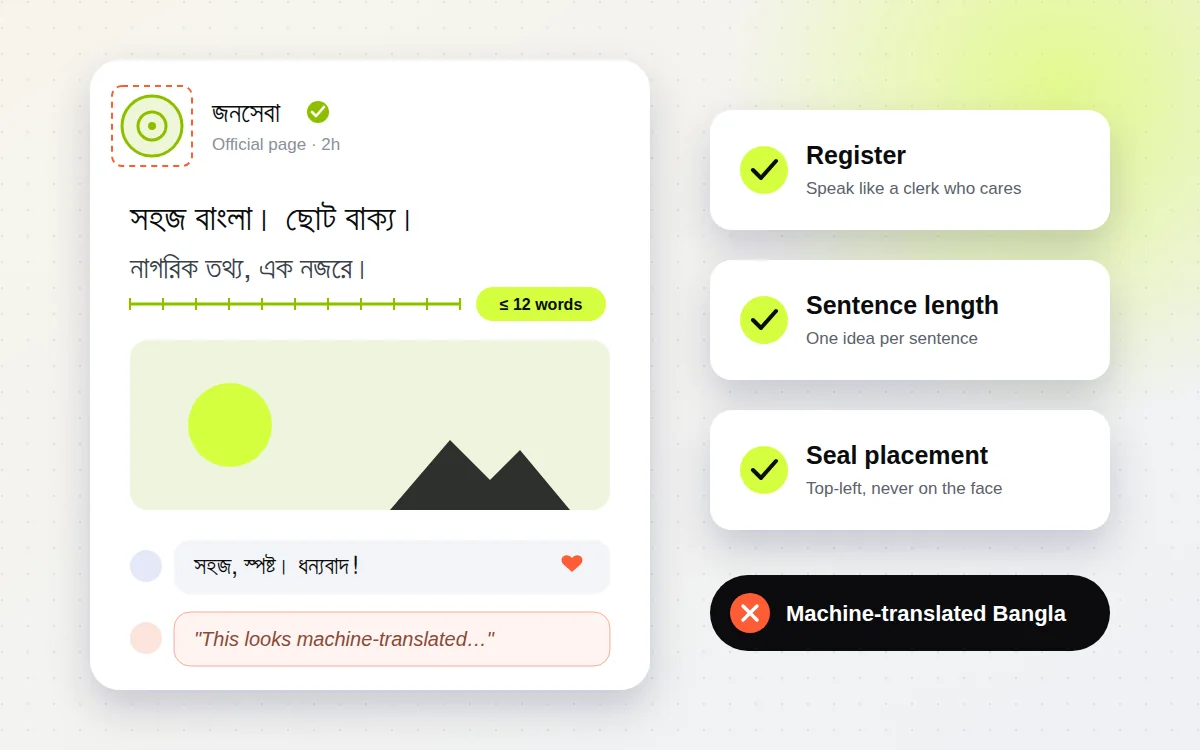
- One idea per sentence. Aim for around twelve words. If a sentence needs a second comma, it probably needs to be two sentences.
- Lead with the action. What is happening, where, when, and what the reader should do — in the first two lines, before the feed cuts the post off behind “See more”.
- Be consistent with numbers. Use Bangla numerals in Bangla posts, and write dates and times in full.
- Explain technical words once. A term like এলএনজি can stay, with one plain line on what it means for the reader.
3. Seal placement: a signature, not decoration
The seal tells a citizen that a post is genuinely official. That only works if it is used the same way every time. For the ministry we built a locked visual system — national seal, bilingual ministry name, a geographically accurate Bangladesh silhouette, and a fixed layout for infrastructure posts, advisory tips and compliance notices.
- Keep the seal in the same corner, at the same size, with clear space around it.
- Never place it over a face, a map, a chart or text.
- Check every map. A wrong border is noticed immediately and remembered for much longer.
Consistency does a second job: it makes the real page easy to tell apart from a copy.
4. Machine-translated Bangla always gets caught
English sentence order, borrowed idioms, the wrong level of respect, technical terms translated word for word — readers spot all of it, and the comments say so within minutes, often with a screenshot. Once a post is known to be machine-translated, nobody trusts the rest of it.
Every Bangla line should be written natively, not translated, and checked twice: first for facts, then for style. Keep an approved glossary for technical and project names so every post uses the same words.
5. Run big moments as a daily operation
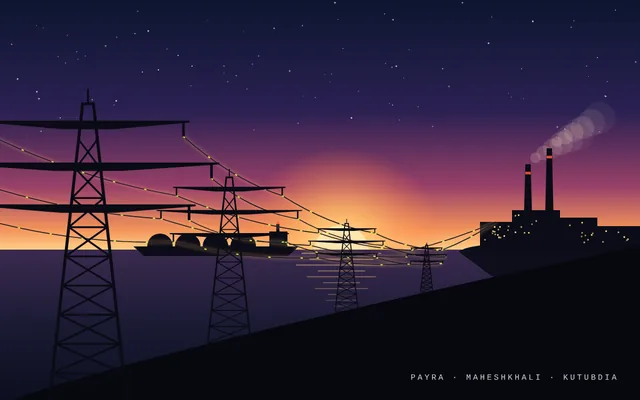
An event week is not one announcement. For Power & Energy Week the ministry’s page ran daily through the full week, with more than ten formats: achievement posts, daily updates, speaker quotes and videos, exhibitor profiles, live coverage and a highlights film, alongside a university activation. Each project — Payra LNG, Maheshkhali, Kutubdia — had its own location-specific creative, in both Bangla and English, written natively.
Before you post
- Can a citizen tell what to do from the first two lines?
- Is every sentence one idea, in everyday Bangla?
- Is the seal in its fixed place, clear of faces, maps and text?
- Have the facts been checked — then the language?
- Do the video captions and the image text read well without sound, on a small screen?
Public communication is judged on a different axis. Get it right, in the language people actually speak, and the page becomes the place citizens check first.