The first question in almost every media conversation is the same: what does a CPM cost here? The honest answer is that there is no price list. A CPM — the cost of a thousand impressions — is the output of an auction, and the auction is different every week. Any single number we published would be wrong within a month.
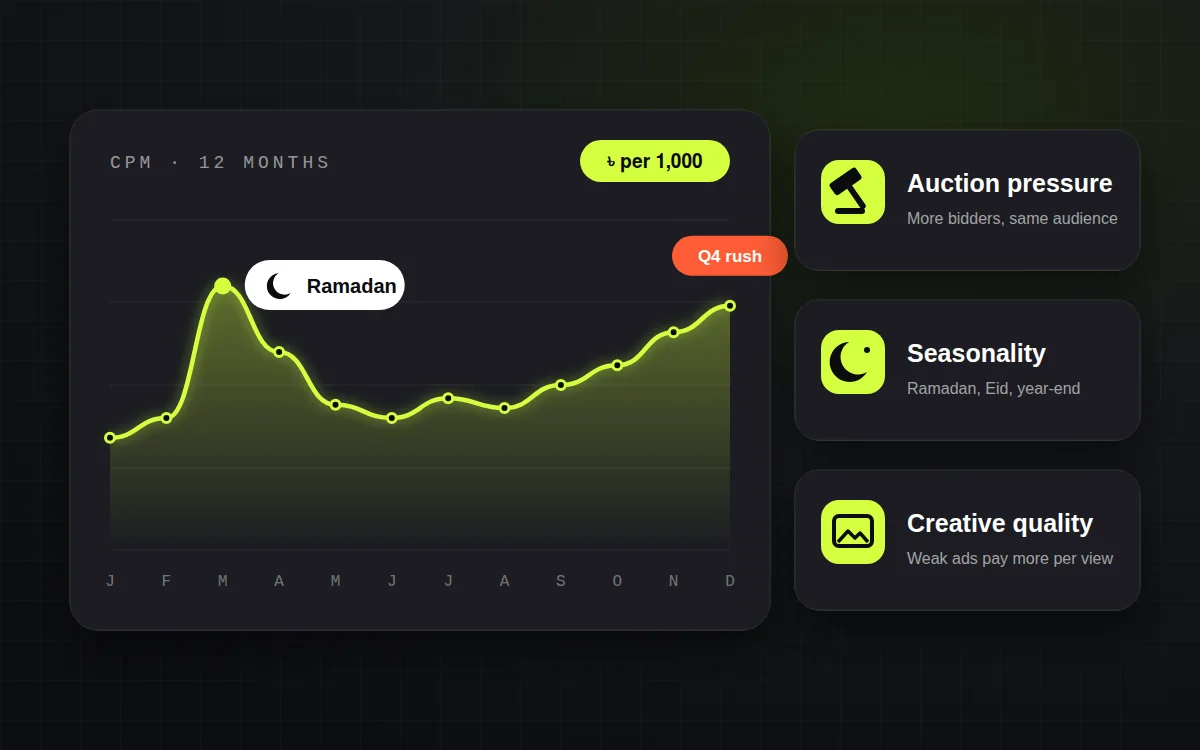
What does not change is what moves it. In Bangladesh, three forces explain most of the difference between a cheap month and an expensive one.
1. Auction pressure: who else is bidding for the same people
Your CPM rises when more advertisers want the same audience, on the same placements, at the same time. That is obvious. What is less obvious is how often advertisers raise their own prices — by targeting audiences so narrowly that the auction has nowhere else to go, or by running six platforms as six separate buys that end up chasing the same people over and over.
When we worked on Berger Paints Bangladesh, media ran across Meta, Google, YouTube Masthead, DV360, programmatic and TikTok. The fix was not a cheaper platform. It was treating the six as one buy: one frequency cap, one measurement framework, and budget moved continuously toward the lowest-CPM, highest-attention placements. Monthly spend grew from BDT 30 lakh to 150 lakh — five times over — while CPM across the mix fell 30%.
Scale is not waste. Efficiency and scale are only a trade-off if the mix is planned channel by channel.
2. Seasonality: Ramadan, Eid and the year-end rush
Demand for attention is not flat. Around Ramadan and Eid, retail, telecom, FMCG and e-commerce all push at once, and the inventory gets expensive for everyone. The year-end brings a second rush. You cannot opt out of the calendar, but you can stop paying peak prices to learn things you could have learned in a quiet month.
- Build before the window opens. For Aarong, the Eid peak was handled as a single campaign with a creative library built in advance and media weight concentrated into the trading period — then shifted toward e-commerce as conversion held. The result was a 24.5× return on ad spend.
- Bid on value, not volume. Shohoz sells bus, air and launch tickets in a market with sharp seasonal peaks. Moving the account to value-based bidding, fed with real purchase data, is what held return on ad spend as costs moved: 6,521% at peak, on 36,500 purchases.
- Buy reach early. Awareness bought in the weeks before a peak is cheaper than awareness bought during it.
3. Creative quality: the cost nobody puts in the plan
Ad platforms do not only sell to the highest bidder. They also weigh how likely people are to engage with an ad. An ad that people scroll past, hide or ignore is delivered less efficiently — which means weak creative quietly raises what you pay for every thousand impressions.
Fatigue does the same thing more slowly. As the same few ads are shown to the same people, frequency rises, response falls, and cost per result drifts up even when the CPM looks stable. For Akash DTH, more than 20 creative variations were tested and optimised weekly. That rhythm matters more than any single brilliant ad.
A cheap CPM can still be expensive
CPM is a cost of attention, not a cost of results. The cheapest impressions are often cheap for a reason: they reach people who will never buy.
City Bank is the clearest example we have. Cost per lead looked healthy, but sales were converting a shrinking share of those leads and the cost of an actual customer was rising. Once the media optimised against a lead-quality score instead of raw leads, qualified leads rose 45% and cost per lead still fell 19%. TallyKhata showed the same pattern for app installs: optimising for what happens after the install brought 2.2 million new users at a 30% lower cost per install.
How to read your own CPM
- Compare against the same weeks last year, not last month. Seasonality hides in month-on-month charts.
- Split it by platform and placement. One expensive placement can drag an average up.
- Check frequency next to it. Rising frequency with falling response is fatigue, not the market.
- Always read it beside cost per result — a lead, a sale, a qualified visit. That is the number the business pays for.
- Scale budget in steps, and let each step prove itself before the next.
If your CPM is climbing, the market is rarely the whole story. Usually it is the plan, the calendar or the creative — and all three can be fixed.