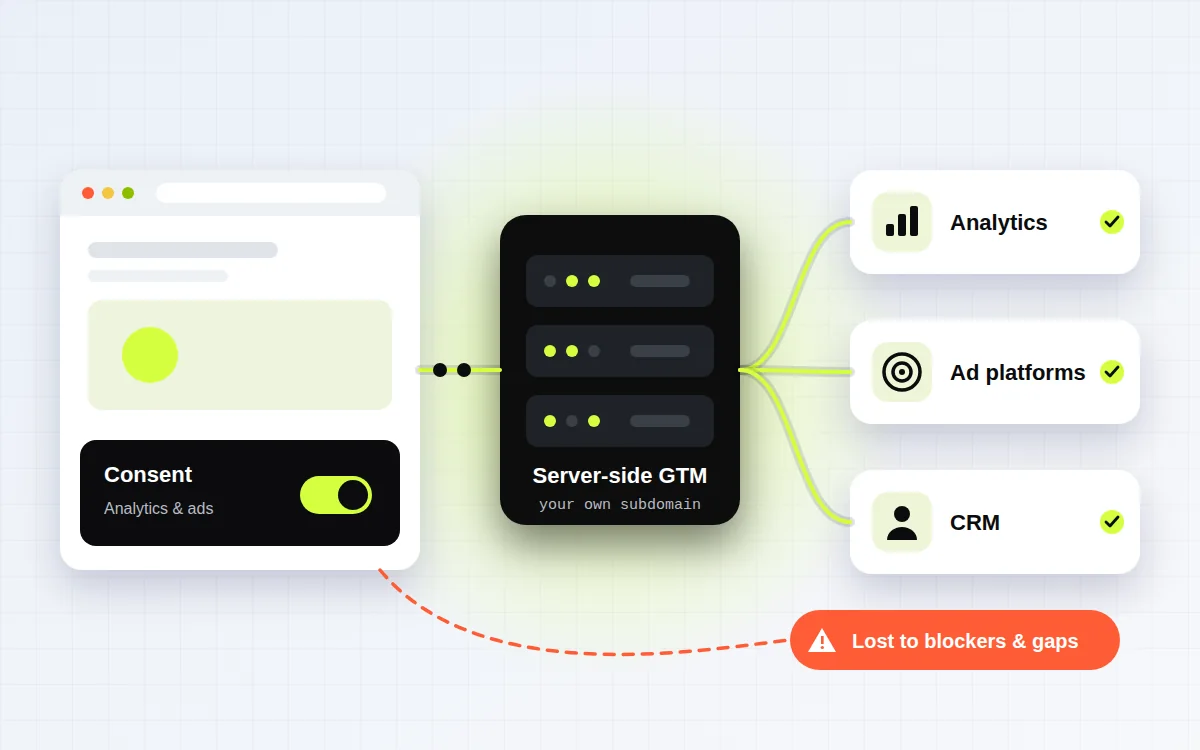
Most accounts in Bangladesh still measure everything from the browser: Google Analytics and the ad platforms’ pixels, loaded through Google Tag Manager on the page. It is easy to set up and it quietly misses conversions — to ad blockers, browser tracking protection, slow connections and in-app browsers. The platforms then optimise on the conversions they can see, not the ones that happened.
That matters more than any bid. When we rebuilt Shohoz’s Google Ads account, most of the gain came before a single bid changed — it came from tracking the right event, with Enhanced Conversions feeding real purchase data back into bidding. The result was a 6,521% return on ad spend.
Server-side tagging moves the tags off the visitor’s browser and onto a server you control, on your own subdomain. It is the right direction. It also breaks in predictable ways.
1. Hosting: where the server lives
A server-side container has to run somewhere, usually on a cloud service such as Google Cloud. There is no Google Cloud region in Bangladesh, so pick the nearest — Mumbai, Delhi or Singapore — rather than the default, and keep a minimum number of instances warm so the first visitors of the morning are not lost to a cold start.
- Use your own subdomain (for example
data.yourbrand.com) with DNS and SSL set up properly. Without it you keep most of the old limits. - Budget the running cost and set an alert. Traffic spikes on sale days raise it.
2. Consent: server-side is not a way around it
Moving tags to a server does not change what a visitor agreed to. The consent choice has to travel with every event, and the server has to respect it. If you serve visitors in the EU or UK, Google’s Consent Mode is required for its advertising features — and wherever the law asks for consent, the server must follow the same rules as the page.
3. The attribution gaps that are specific to Bangladesh
Payment gateway redirects. Checkouts through SSLCommerz, bKash or Nagad send the customer to the gateway and back. If analytics is not told otherwise, the purchase is credited to the gateway as a referral and the campaign that brought the customer gets nothing. Add the gateways to your unwanted referrals, keep the order ID through the redirect, and send the purchase from the server when payment is confirmed — not from the thank-you page, which not every customer reaches.
Cash on delivery. An order placed is not revenue earned. Send the confirmed or delivered value back to the platforms later, as an offline conversion, so bidding learns from real sales rather than orders that were refused at the door.
Offline and field sales. For Akash DTH, online advertising fed a field-sales business. Paid campaigns were wired into a live CRM and measured end to end through GA4 and the Meta Conversions API; 64% of leads were closed through that CRM and field-sales sync, and 47,000+ subscribers came in 80 days. The same principle connected property-site visits back to their media source for Rancon.
4. Double counting
During a migration it is common to send the same purchase from both the browser and the server. Unless both carry the same event ID, the platform counts it twice and your reported results look better than the business. Deduplicate before you celebrate.
5. Proving it works
Our checklist before anyone trusts the numbers
- A written tracking plan: which events, which values, which platforms.
- A test report showing every event fires — from the browser and from the server.
- Weekly comparison of platform-reported conversions against orders in the backend.
- Hashed customer data (email, phone in +880 format) sent only with consent, for Enhanced Conversions and the Conversions API.
- An alert when conversions drop to zero, because one day they will.
Server-side tracking will not make a weak campaign strong. What it does is show the platforms — and you — what really happened. Every good optimisation starts there.